🌾 Dietary fibre : Why is fibre so good for you and are you getting enough? 🥦
Most of us eat only half the fibre we need. Yet fibre keeps you regular, feeds your gut bacteria, lowers cholesterol, may help dissolve blood clots and is linked to less heart disease, diabetes and bowel cancer, and a longer life. Discover how to close your fibre gap 🌾

The numbers in brackets, like (15), point to the studies in the reference list at the bottom 📚, so you can dig deeper into anything that sparks your curiosity. 🔍
⚡ The short version
✅ Dietary fibre is the part of plant foods that your body cannot digest. It travels to your large bowel, where it feeds your gut bacteria 🦠 (1, 2).
✅ Adults need at least 25 g of fibre a day (about 25 g for women and 38 g for men), but most people eat far less 📉 (3–5).
✅ Fibre keeps you regular 🚽 by making stools softer, bulkier and easier to pass (6).
✅ People who eat more fibre have less heart disease, stroke, type 2 diabetes and bowel cancer and they live longer ❤️ (7, 8).
✅ Fibre-rich foods help you feel fuller 😌 and may support a healthy weight (9, 10).
✅ Some fibres, such as oat bran and guar gum, may help your body dissolve blood clots more easily 🩸 (11, 12).
💨 More gas at first is normal when increasing fibre intake and your gut usually adapts within a few weeks (13, 14).
⚠️ Fibre may not work the same way for everyone: early research suggests your genes 🧬 may influence how much you benefit (15, 16).
🌱 Why fibre matters
Fibre used to be dismissed as mere "roughage" that passes through the body unused. We now know it plays a key role in the health of your gut, heart and metabolism (1).
🔬 Two ways fibre works: some benefits come directly from fibre's physical properties in the gut (such as forming a gel or adding bulk), and others come from what happens when your gut bacteria ferment it, producing helpful substances called short-chain fatty acids (1, 17).
📉 The "fibre gap": even though fibre is linked to better health, most people around the world eat far less than recommended (7, 18).
🥦 What is fibre, and where is it found?
| 🌾 Type | What it does | Where to find it |
|---|---|---|
| Soluble fibre | Forms a gel that slows the absorption of sugar and fat, lowers cholesterol and feeds gut bacteria | Oats, barley, beans, lentils, apples and citrus fruits |
| Insoluble fibre | Holds water and adds bulk to stools, helping to keep you regular | Whole grains, nuts, beans and vegetables such as cauliflower, green beans and potatoes |
🥔 Resistant starch: some starch escapes digestion and behaves like a fermentable fibre in the large bowel (2).
🍎 Mix it up: most plant foods contain both types, so eating a variety of fibre-rich foods gives you the widest range of benefits (6, 9).
🏭 Processing matters: refining grain removes the fibre-rich bran and germ, so white flour, white rice and many breads and pastas contain much less fibre than whole grains such as whole wheat, brown rice and oats. Peeling fruit and vegetables removes fibre found in the skin, and juicing removes most of it: orange juice has far less fibre than a whole orange 🍊 (19).
🔥 Cooking: boiling can wash some fibre into the cooking water, whereas steaming and microwaving usually keep more of it. Some breakfast cereals and snack bars have fibre added back (19).
📏 How much do we need? The US Institute of Medicine recommends about 25 g a day for women and 38 g a day for men (3), European experts consider 25 g a day enough for normal bowel function (20), and the World Health Organisation recommends at least 25 g a day from foods (4). The greatest health benefits are seen at about 25–29 g a day or more (7).
📉 Reality check: young Austrian adults ate on average 15.7 g a day, and only 7% reached 25 g (5). Spanish adults ate only about 13–16 g a day (21).
🌟 What does the research say?
Not all evidence is equally strong, so look out for these symbols:
⭐ = based on a review of many studies or a randomised controlled trial (stronger evidence)
🔹 = based on observational research that shows a link but not cause and effect
🐭 = based on animal or lab research (still needs testing in people)
🚽 Digestion and regularity
⭐ A review of 113 trials found that eating more fibre led to small but consistent improvements in bowel habits: softer stools, more frequent bowel movements and faster passage through the gut. The less soluble, "bulking" fibres, such as wheat bran, worked best (6).
⭐ A review of trials found that fibre roughly halved the risk of persistent symptoms and bleeding from haemorrhoids (piles) (22).
🔹 In more than 47,000 British adults, people who ate the most fibre were less likely to develop diverticular disease, a condition in which small pouches form in the wall of the bowel (23).
💨 Gas: a sign of a busy gut
When gut bacteria ferment fibre, they produce gas (mainly hydrogen, carbon dioxide and methane). Passing some gas is a normal sign of a healthy, active gut 🦠, and a diverse community of gut bacteria is linked to better digestion (13, 24).
🔹 In three feeding studies, fewer than half of the adults who started eating beans every day noticed more gas, and complaints faded over the following weeks as the gut adapted (14).
⚠️ Excessive gas that does not settle may point to too many gas-producing foods or to conditions such as irritable bowel syndrome, lactose intolerance or bacterial overgrowth.
⭐ Probiotics may ease symptoms such as bloating and gas in some people with irritable bowel syndrome (25), but the best first step is to increase fibre slowly.
❤️ Heart health and cholesterol
⭐ A review of 67 trials found that soluble fibre lowers "bad" LDL cholesterol (26). It does this by trapping bile acids in the gut, which forces the liver to use up cholesterol to make new bile acids (27).
⭐ Fibre supplements slightly lowered blood pressure, especially in older people and people with high blood pressure (28).
⭐ Reviews of many long-term studies found that people who ate the most fibre had less heart disease and stroke and were less likely to die from them (7).
🔹 Fibre is no excuse for a salty diet: in 8,354 Korean adults, eating more fibre did not cancel out the link between a high-salt, low-potassium diet and high blood pressure (29).
🩸 Fibre and blood clotting
Your blood has to strike a careful balance: it must clot to stop bleeding, but it must also dissolve clots so they don't block blood vessels and cause a heart attack or stroke. Two key players are fibrinogen, the protein that forms the clot, and PAI-1, which acts as a brake on clot-dissolving 🛑. High levels of both are linked to heart disease (30).
🔹 In about 21,000 British adults, people who ate more fibre had lower fibrinogen (31), and a similar link was found in black South Africans in the THUSA study 🇿🇦 (32). In 1,701 adults with type 2 diabetes, people who ate more fibre had lower PAI-1 (33).
⭐ In trials, guar gum (11), oat bran (12) and beans (34) lowered PAI-1, which means the body could dissolve clots more easily. Oat bran lowered PAI-1 by 30% in just two weeks (12).
⭐ Pectin (the fibre in apples and citrus fruits) did not change fibrinogen levels but made blood clots looser and easier to break down (35).
⭐ Effects on fibrinogen itself are mixed: a high-fibre diet lowered fibrinogen in one trial (36) but not in another (37).
🧬 Genetic studies suggest that fibrinogen levels on their own may not directly cause heart disease (38), so fibre's main benefit may come from helping the body break down clots.
🩺 Blood sugar and diabetes
⭐ Sticky, gel-forming fibres slow down how quickly sugar enters the blood after a meal (39).
⭐ People who eat the most fibre have a lower risk of developing type 2 diabetes (7), and in people who already have diabetes, eating more fibre improved blood sugar control (HbA1c), cholesterol and body weight (40).
⚖️ Fullness and weight
⭐ A review of trials found that the type of fibre matters: thick, gel-forming fibres most consistently reduced appetite (9).
🔹 In more than 74,000 American nurses, women whose fibre intake increased the most over 12 years gained 1.5 kg less and had a 49% lower risk of major weight gain (10).
🔹 In 345 adults on a weight-loss diet, fibre intake was the strongest predictor of weight loss, regardless of calories or the mix of fat, protein and carbohydrate (41).
🔹 Not every study agrees: in 728 young adults in rural Limpopo, South Africa 🇿🇦, fibre intake was not linked to body weight (42), and in Australian adults the link weakened once the rest of the diet and lifestyle were taken into account (43). Fibre helps most as part of an overall healthy eating pattern.
🎗️ Cancer
⭐ A large review of 25 reviews found that people who ate the most fibre had a 22% lower risk of cancer and a 17% lower risk of dying from cancer, with benefits for cancers of the digestive system and breast (8).
⭐ For bowel cancer, every extra 10 g of fibre a day was linked to about a 10% lower risk, especially fibre from cereals and whole grains 🌾 (44).
⭐ A review including nearly 3 million people found that every extra 5 g of fibre a day was linked to an 8% lower risk of lung cancer (45).
🔹 In a large US cancer screening study, men who ate more fibre were less likely to die early, and in some analyses had a lower risk of prostate cancer (46).
🔹 Bowel cancer is becoming more common in younger adults (47). Early findings, not yet fully published, suggest that low-fibre, high-sugar diets may encourage harmful gut bacteria linked to bowel cancer.
💪 Muscle and healthy ageing
🔹 In US adults aged 40 and older, people who ate more fibre had more muscle and stronger muscles (48), but this needs to be confirmed in long-term studies.
🤰 Pregnancy and children's behaviour
🔹 In a large Norwegian study, mothers who ate more fibre during pregnancy had children with fewer ADHD symptoms in early childhood (49). This needs to be confirmed in other populations.
⏳ Living longer
⭐ People who ate the most fibre had a 15–30% lower risk of dying early from any cause, including heart disease, than people who ate the least (7).
🧬 Your genes and fibre
🔹 In more than 24,000 Swedish adults, fibre was linked to a lower risk of type 2 diabetes only in people without a high-risk variant of the TCF7L2 gene (15).
🔹 In Iranian adults, fibre appeared to benefit people carrying obesity-risk variants of the FTO gene the most (50).
⭐ In Chinese adults, oats lowered LDL cholesterol more in people with one version of the CYP7A1 gene (16), but a Canadian trial found the opposite (51), so more research is needed.
🔹 In older Dutch adults, fibre was linked to lower levels of the clotting factor FVII, but mainly in people with a particular version of the FVII gene (52).
🔹 In nearly 70,000 people, the protective link between fibre and bowel cancer was slightly stronger in people with certain variants near the SLC26A3 gene (53).
🎲 Mendelian randomisation uses the genes we inherit at random as a "natural experiment" to test cause and effect. These studies suggest that eating more cereals may lower bowel cancer risk (54), whereas a link with fruit disappeared once other foods were taken into account (55). The evidence is still weak because the genes used mainly predict food choices, which also reflect education, income and body weight. For now, the best evidence still comes from controlled trials and large long-term studies.
🥗 How to eat more fibre
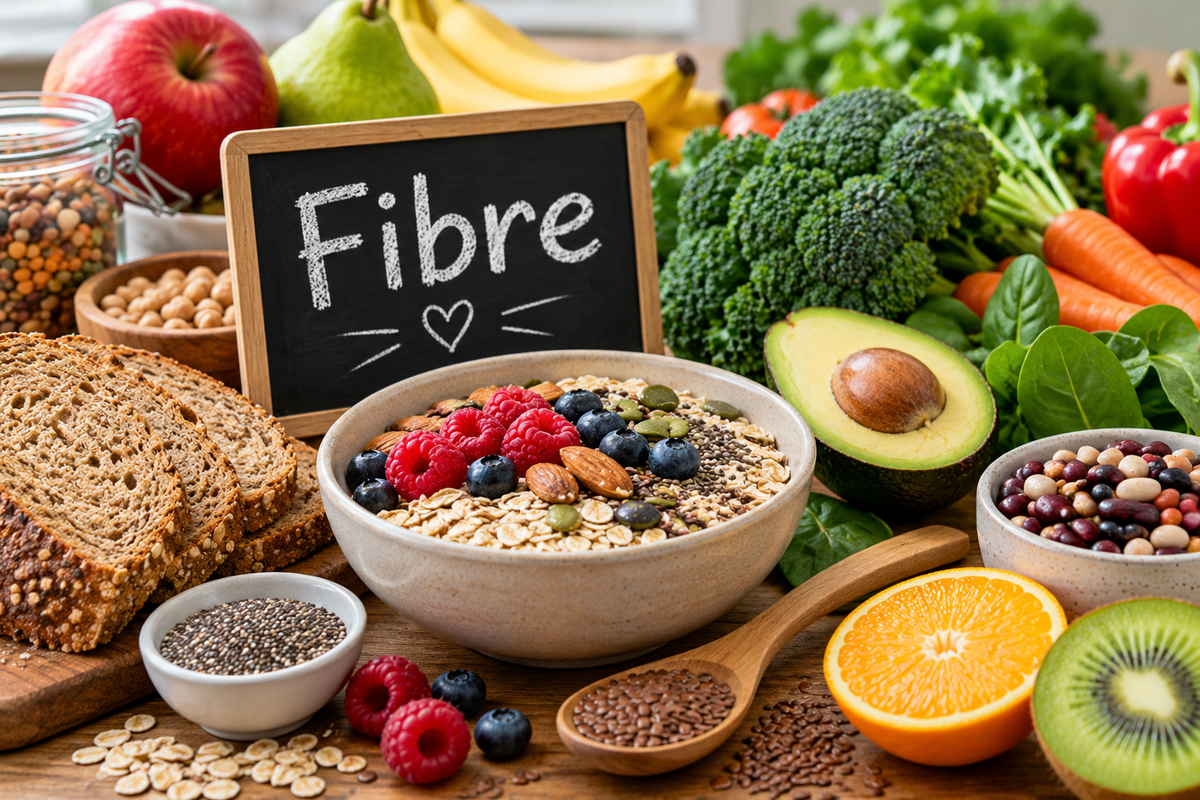
🍎 Eat more fruit and vegetables of different colours, and choose whole fruit rather than juice
🍞 Swap refined grains for whole grains, such as whole-wheat bread, brown rice, oats and quinoa
🫘 Add beans, lentils and peas to soups, salads and main dishes
🥜 Snack on nuts and seeds, which also provide healthy fats
🏷️ Read food labels and look for products that are "high in fibre" or a "source of fibre"
🐢 Increase fibre slowly and drink enough fluids, so your gut has time to adapt and you have less gas and discomfort
🎯 The bottom line
✅ Fibre is one of the simplest and most affordable ways to protect your gut, heart and metabolism.
📏 Aim for at least 25 g of fibre a day from a variety of plant foods: whole grains, legumes, vegetables, fruit, nuts and seeds.
🍽️ Fibre works best as part of an overall healthy eating pattern, not as a quick fix.
🌾 Choose foods that are as close to their natural form as possible: whole grains instead of refined grains, and whole fruit instead of juice.
🧬 Your genes may influence how much you benefit, but this research is still early, so fibre-rich eating is good advice for everyone.
💭 Questions to ask yourself
🔢 How much fibre do I eat each day? Am I anywhere near 25 g?
🍞 Could I switch to whole-grain bread, brown rice or oats instead of refined versions?
🫘 How often do I eat beans, lentils or peas? Could I add them to a meal or two each week?
🍊 Do I drink my fruit as juice? Could I eat the whole fruit instead?
🐢 Am I increasing my fibre slowly enough to give my gut time to adjust?
💌 Love what you're reading? Share the knowledge! Forward this link to a friend who might also enjoy it. 📨
📚 References
Want to go deeper? Here are all the studies behind this summary. 🔍
1. Akhlaghi M. The role of dietary fibers in regulating appetite, an overview of mechanisms and weight consequences. Critical Reviews in Food Science and Nutrition. 2024;64:3139-50.
2. Codex Alimentarius Commission. Report of the 30th Session of the Codex Committee on Nutrition and Foods for Special Dietary Uses (ALINORM 09/32/26). Rome: FAO/WHO; 2009.
3. Institute of Medicine. Dietary Reference Intakes for Energy, Carbohydrate, Fiber, Fat, Fatty Acids, Cholesterol, Protein, and Amino Acids. Washington, DC: The National Academies Press; 2005.
4. World Health Organization. Carbohydrate intake for adults and children: WHO guideline. Geneva: World Health Organization; 2023.
5. Greier MdC, Dudas J, Greier K, Posch M, Hofauer BG. Dietary fiber intake and weight status in young Austrian adults. Foods. 2025;14:3863.
6. Balk EM, Couch E, Mai HJ, Chen Y, Adam GP, Kanaan G, et al. Fiber intake and laxation in people with normal bowel function: a systematic review. The American Journal of Clinical Nutrition. 2026;123:101212.
7. Reynolds A, Mann J, Cummings J, Winter N, Mete E, Te Morenga L. Carbohydrate quality and human health: a series of systematic reviews and meta-analyses. Lancet. 2019;393(10170):434-45.
8. Arayici ME, Basbinar Y, Ellidokuz H. High and low dietary fiber consumption and cancer risk: a comprehensive umbrella review with meta-meta-analysis involving meta-analyses of observational epidemiological studies. Critical Reviews in Food Science and Nutrition. 2025;65:1617-30.
9. Wanders AJ, van den Borne JJGC, de Graaf C, Hulshof T, Jonathan MC, Kristensen M, et al. Effects of dietary fibre on subjective appetite, energy intake and body weight: a systematic review of randomized controlled trials. Obesity Reviews. 2011;12(9):724-39.
10. Liu S, Willett WC, Manson JE, Hu FB, Rosner B, Colditz G. Relation between changes in intakes of dietary fiber and grain products and changes in weight and development of obesity among middle-aged women. The American Journal of Clinical Nutrition. 2003;78(5):920-7.
11. Landin K, Holm G, Tengborn L, et al. Guar gum improves insulin sensitivity, blood lipids, blood pressure, and fibrinolysis in healthy men. The American Journal of Clinical Nutrition. 1992;56:1061-5.
12. Kristensen M, Bügel S. A diet rich in oat bran improves blood lipids and hemostatic factors, and reduces apparent energy digestibility in young healthy volunteers. European Journal of Clinical Nutrition. 2011;65:1053-8.
13. Tomlin J, Lowis C, Read NW. Investigation of normal flatus production in healthy volunteers. Gut. 1991;32(6):665-9.
14. Winham DM, Hutchins AM. Perceptions of flatulence from bean consumption among adults in 3 feeding studies. Nutrition Journal. 2011;10:128.
15. Hindy G, Sonestedt E, Ericson U, et al. Role of TCF7L2 risk variant and dietary fibre intake on incident type 2 diabetes. Diabetologia. 2012;55(10):2646-54.
16. Ye M, Sun J, Chen Y, Ren Q, Zhao Y, Pan Y, et al. Response of serum LDL cholesterol to oatmeal consumption depends on CYP7A1_rs3808607 genotype in Chinese. Asia Pacific Journal of Clinical Nutrition. 2020;29(2):423-33.
17. Koh A, De Vadder F, Kovatcheva-Datchary P, Bäckhed F. From dietary fiber to host physiology: short-chain fatty acids as key bacterial metabolites. Cell. 2016;165(6):1332-45.
18. Jones JM. CODEX-aligned dietary fiber definitions help to bridge the 'fiber gap'. Nutrition Journal. 2014;13:34.
19. Dhingra D, Michael M, Rajput H, Patil RT. Dietary fibre in foods: a review. Journal of Food Science and Technology. 2012;49(3):255-66.
20. EFSA Panel on Dietetic Products, Nutrition, and Allergies (NDA). Scientific opinion on dietary reference values for carbohydrates and dietary fibre. EFSA Journal. 2010;8(3):1462.
21. González-Rodríguez LG, Perea Sánchez JM, Aranceta-Bartrina J, Gil Á, González-Gross M, Serra-Majem L, et al. Intake and dietary food sources of fibre in Spain: differences with regard to the prevalence of excess body weight and abdominal obesity in adults of the ANIBES study. Nutrients. 2017;9(4):326.
22. Alonso-Coello P, Mills E, Heels-Ansdell D, et al. Fiber for the treatment of hemorrhoids complications: a systematic review and meta-analysis. The American Journal of Gastroenterology. 2006;101(1):181-8.
23. Crowe FL, Appleby PN, Allen NE, Key TJ. Diet and risk of diverticular disease in Oxford cohort of European Prospective Investigation into Cancer and Nutrition (EPIC): prospective study of British vegetarians and non-vegetarians. BMJ. 2011;343:d4131.
24. Makki K, Deehan EC, Walter J, Bäckhed F. The impact of dietary fiber on gut microbiota in host health and disease. Cell Host & Microbe. 2018;23(6):705-15.
25. Ford AC, Harris LA, Lacy BE, Quigley EMM, Moayyedi P. Systematic review with meta-analysis: the efficacy of prebiotics, probiotics, synbiotics and antibiotics in irritable bowel syndrome. Alimentary Pharmacology & Therapeutics. 2018;48(10):1044-60.
26. Brown L, Rosner B, Willett WW, Sacks FM. Cholesterol-lowering effects of dietary fiber: a meta-analysis. The American Journal of Clinical Nutrition. 1999;69(1):30-42.
27. Gunness P, Gidley MJ. Mechanisms underlying the cholesterol-lowering properties of soluble dietary fibre polysaccharides. Food & Function. 2010;1(2):149-55.
28. Streppel MT, Arends LR, van 't Veer P, Grobbee DE, Geleijnse JM. Dietary fiber and blood pressure: a meta-analysis of randomized placebo-controlled trials. Archives of Internal Medicine. 2005;165(2):150-6.
29. Dundar C. When fiber does not protect: evaluating statistical interaction between dietary fiber, sodium-to-potassium ratio, and metabolic syndrome in South Korean adults. Healthcare. 2026;14:3145.
30. Vorster HH, Cummings JH, Jerling JC. Diet and haemostatic processes. Nutrition Research Reviews. 1997;10:115-35.
31. Freitas R, Luben R, Wareham N, et al. Relationship between plasma fibrinogen and fiber intake in the EPIC-Norfolk cohort. European Journal of Clinical Nutrition. 2012;66:443-51.
32. James S, Vorster HH, Venter CS, et al. Nutritional status influences plasma fibrinogen concentration: evidence from the THUSA survey. Thrombosis Research. 2000;98:383-94.
33. Belalcazar LM, Anderson AM, Lang W, et al. Fiber intake and plasminogen activator inhibitor-1 in type 2 diabetes: Look AHEAD (Action for Health in Diabetes) trial findings at baseline and year 1. Journal of the Academy of Nutrition and Dietetics. 2014;114:1800-10.e2.
34. Oosthuizen W, Scholtz CS, Vorster HH, et al. Extruded dry beans and serum lipoprotein and plasma haemostatic factors in hyperlipidaemic men. European Journal of Clinical Nutrition. 2000;54:373-9.
35. Veldman FJ, Nair CH, Vorster HH, et al. Dietary pectin influences fibrin network structure in hypercholesterolaemic subjects. Thrombosis Research. 1997;86:183-96.
36. Johansson-Persson A, Ulmius M, Cloetens L, et al. A high intake of dietary fiber influences C-reactive protein and fibrinogen, but not glucose and lipid metabolism, in mildly hypercholesterolemic subjects. European Journal of Nutrition. 2014;53:39-48.
37. Fehily AM, Burr ML, Butland BK, et al. A randomised controlled trial to investigate the effect of a high fibre diet on blood pressure and plasma fibrinogen. Journal of Epidemiology and Community Health. 1986;40:334-7.
38. Sabater-Lleal M, Huang J, Chasman D, et al. Multiethnic meta-analysis of genome-wide association studies in >100 000 subjects identifies 23 fibrinogen-associated loci but no strong evidence of a causal association between circulating fibrinogen and cardiovascular disease. Circulation. 2013;128(12):1310-24.
39. Jenkins DJA, Wolever TMS, Leeds AR, et al. Dietary fibres, fibre analogues, and glucose tolerance: importance of viscosity. British Medical Journal. 1978;1(6124):1392-4.
40. Reynolds AN, Akerman AP, Mann J. Dietary fibre and whole grains in diabetes management: systematic review and meta-analyses. PLoS Medicine. 2020;17(3):e1003053.
41. Miketinas DC, Bray GA, Beyl RA, Ryan DH, Sacks FM, Champagne CM. Fiber intake predicts weight loss and dietary adherence in adults consuming calorie-restricted diets: the POUNDS Lost (Preventing Overweight Using Novel Dietary Strategies) study. The Journal of Nutrition. 2019;149:1742-8.
42. Mashiane JTM, Monyeki KD, Kengne AP, Nkwana MR, Monyeki MS. Ellisras Longitudinal Study 2017: the relationship between dietary intake and body mass index among young rural adults in South Africa aged 18 to 30 years (ELS 18). Cardiovascular Journal of Africa. 2018;29:301-4.
43. Fayet-Moore F, Petocz P, McConnell A, Tuck K, Mansour M. The cross-sectional association between consumption of the recommended five food group "grain (cereal)", dietary fibre and anthropometric measures among Australian adults. Nutrients. 2017;9:157.
44. Aune D, Chan DSM, Lau R, et al. Dietary fibre, whole grains, and risk of colorectal cancer: systematic review and dose-response meta-analysis of prospective studies. BMJ. 2011;343:d6617.
45. Fathzadeh K, Kazeminejad S, Balali A, Azadbakht L. The association between dietary fiber intake and risk of lung cancer: a GRADE-assessed systematic review and dose response meta-analysis of prospective cohort studies. Nutrition Journal. 2026;25.
46. Yang DY, Wang PY, Wu MH, Geyer DNR, McDonald PAC, Wang PM. Dietary fiber intake and prostate cancer outcomes and all-cause mortality: findings from a secondary analysis of the Prostate, Lung, Colorectal, and Ovarian Cancer Screening Study. Journal of the Academy of Nutrition and Dietetics. 2025;125:1718-29.
47. Bailey CE, Hu CY, You YN, et al. Increasing disparities in the age-related incidences of colon and rectal cancers in the United States, 1975-2010. JAMA Surgery. 2015;150(1):17-22.
48. Frampton J, Murphy KG, Frost G, Chambers ES. Higher dietary fibre intake is associated with increased skeletal muscle mass and strength in adults aged 40 years and older. Journal of Cachexia, Sarcopenia and Muscle. 2021;12:2134-44.
49. Solberg BS, Kvalvik LG, Instanes JT, Hartman CA, Klungsøyr K, Li L, et al. Maternal fiber intake during pregnancy and development of attention-deficit/hyperactivity disorder symptoms across childhood: the Norwegian Mother, Father, and Child Cohort Study. Biological Psychiatry. 2024;95:839-48.
50. Hosseini-Esfahani F, Koochakpoor G, Daneshpour MS, et al. The interaction of fat mass and obesity associated gene polymorphisms and dietary fiber intake in relation to obesity phenotypes. Scientific Reports. 2017;7:18057.
51. Wang Y, Harding SV, Thandapilly SJ, Tosh SM, Jones PJH, Ames NP. Barley β-glucan reduces blood cholesterol levels via interrupting bile acid metabolism. British Journal of Nutrition. 2017;118(10):822-9.
52. Mennen LI, de Maat MPM, Schouten EG, Kluft C, Witteman JCM, Hofman A, et al. Dietary effects on coagulation factor VII vary across genotypes of the R/Q353 polymorphism in elderly people. The Journal of Nutrition. 1998;128:870-4.
53. Papadimitriou N, Kim A, Kawaguchi ES, et al. Genome-wide interaction study of dietary intake of fibre, fruits, and vegetables with risk of colorectal cancer. eBioMedicine. 2024;104:105146.
54. Zhang X, Wu Z, Wang X, Xin B, Hu P, Yin Y, et al. Causal associations between dietary factors and colorectal cancer risk: a Mendelian randomization study. Frontiers in Nutrition. 2024;11:1388732.
55. Hoang T, Cho S, Choi JY, Kang D, Shin A. Genetically predicted dietary intake and risks of colorectal cancer: a Mendelian randomisation study. BMC Cancer. 2024;24.